It’s been an interesting thing, living through the spread and subsequent social distancing and quarantines of COVID-19. There are a myriad of articles and thinkpieces and even memes about its impact. I won’t belabour the significance of this time period — many others have said my thoughts much more eloquently — but I do want to talk about information management and its clear importance in such times.
Why is information management important right now?
In short, good information management is what allows organizations to exchange their research, enables governments to inform the public, and arms the general public with crucial awareness of how to #flattenthecurve.
If you’ve been online at any point over the last several months, you’ve seen the effects of this information flow, and you’ve likely participated in it. If you live in Canada, it’s probably been particularly omnipresent over the last two weeks.
Governments, public health agencies, corporations, and local organizations have all mobilized to inform the public of proper protocols to follow as COVID-19 rapidly spreads. Social media channels are flooded with posts from individuals and small business owners. Every company you’ve ever given your email address to (along with some you’d swear you hadn’t) is sending emails about their response to the pandemic. It’s impossible to be online these days without coming across COVID-19 related material. If you’ve been to stores or video chatted with friends, you’ve probably shared what you last heard about borders closing, restrictions on gathering sizes, the cancellation of important events, mass layoffs and income assistance, or any number of other major upsets.
So in this onslaught of omnipresent and rapidly changing information, what can we learn from how the folks with the stats and expertise are informing the public and fighting misinformation? Two key lessons are emerging: the importance of meeting people where they are, and the urgency for sharing research data widely.
Meet people where they are
Part of having good information management means making data and information:
- Easy to find
- Easy to understand
- Reliable (i.e., verified and up-to-date)
Information from official sources has undergone frequent, and sometime substantive, changes in the last few weeks, meaning that some folks are still armed with old, now-inaccurate information. Current opportunities for misinformation and incorrect information to spread are endless.
Governments, public health agencies, and other organizations need to be especially proactive in sharing the right information at the right time to the right audience. And audiences need to be met where they are: on social media, with easy to read and easy to share info.
Example 1: Public Health Agency of Canada

One of the more striking instances of good IM practices comes from the Public Health Agency of Canada. Public Health has been incredibly proactive in spreading information on social media through partnership with social media giants like YouTube. Its dedicated COVID-19 information page has been widely advertised across various social media platforms. In this screenshot from the YouTube mobile app, a link to the Government of Canada’s official COVID-19 page has been directly inserted into the recommendations feed.
Embedding this message directly in the app will likely make more users aware of this official source of info. If this were instead shared directly on the Public Health Agency’s YouTube page, which has fewer than 1,000 subscribers, its reach would be almost non-existent.
Example 2: Centers for Disease Control and Prevention (CDC)
The CDC has also been effectively distributing information using good IM principles, but via different means.
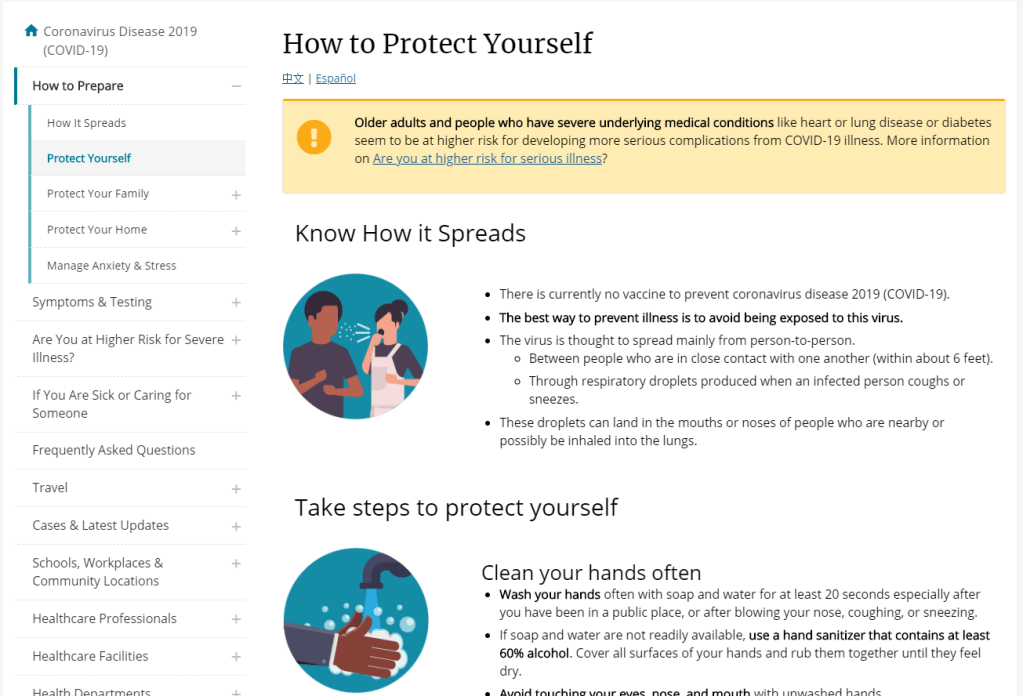
This webpage from the Centers for Disease Control and Prevention (CDC) is an excellent example of information that is presented clearly. There are visually interesting elements, the language used is accessible, and the information is well-organized.
The CDC’s Facebook page has other examples of posts that combine text and visual elements to provide key information to the public, while also linking back to longer form information from the official CDC COVID-19 info page. Many of these are highly shared and show a lot of user engagement through reactions and comments.
Make your research data widely available (and follow FAIR principles)
Another phenomenon that’s been clearly highlighted of late is the importance of sharing research data between scientists, epidemiologists, and governments. As researchers clamour to find a vaccine or other novel medical intervention to lessen the damage caused by COVID-19, it is vital that emerging data is shared widely and freely.
Following FAIR principles can facilitate this, and I do hope that a result of this time is a greater adoption of these principles on a global scale. FAIR principles require data to be:
- Findable
- Accessible
- Interoperable
- Reusable
A great example of making research data available is coming from the World Health Organization (WHO). WHO has been maintaining a database of all COVID-19 related research at a global level, which is updated daily, Monday to Friday. Users can sort by author, journal, topic, and keyword – an invaluable tool for reseachers who need a round-up of the latest data and information. Helpfully, the sources from a wide array of journals and other sources on an international scale, meaning that the global north-weighted bias is, in this case at least, minimized.
It’s also important to note that data-sharing between public and private organizations is not only useful, but almost essential in these times. There is immense value that can come from combining the technology and algorithmic capacity of private firms with (anonymized, aggregate) public health data. For example, Canadian firm Blue Dot successfully predicted the spread of the novel coronavirus by using an AI algorithm that goes beyond existing public health data to “bring together news stories in dozens of languages, reports from plant and animal disease tracking networks and airline ticketing data,” as Vandana Janeja writes for RealKM.
Resources for Data Visualization
If you like data visualization, send me some suggestions for this list!
- COVID-19 Global Cases – GIS visualization by the Center for Systems Science and Engineering (CSSE) at Johns Hopkins University
- The Washington Post’s exponential curve simulator
- How to Tell if We’re Beating COVID-19, from minutephysics [Youtube Video]
- Worldometer’s Coronavirus updates
 Katherine Luber
Leave a comment